
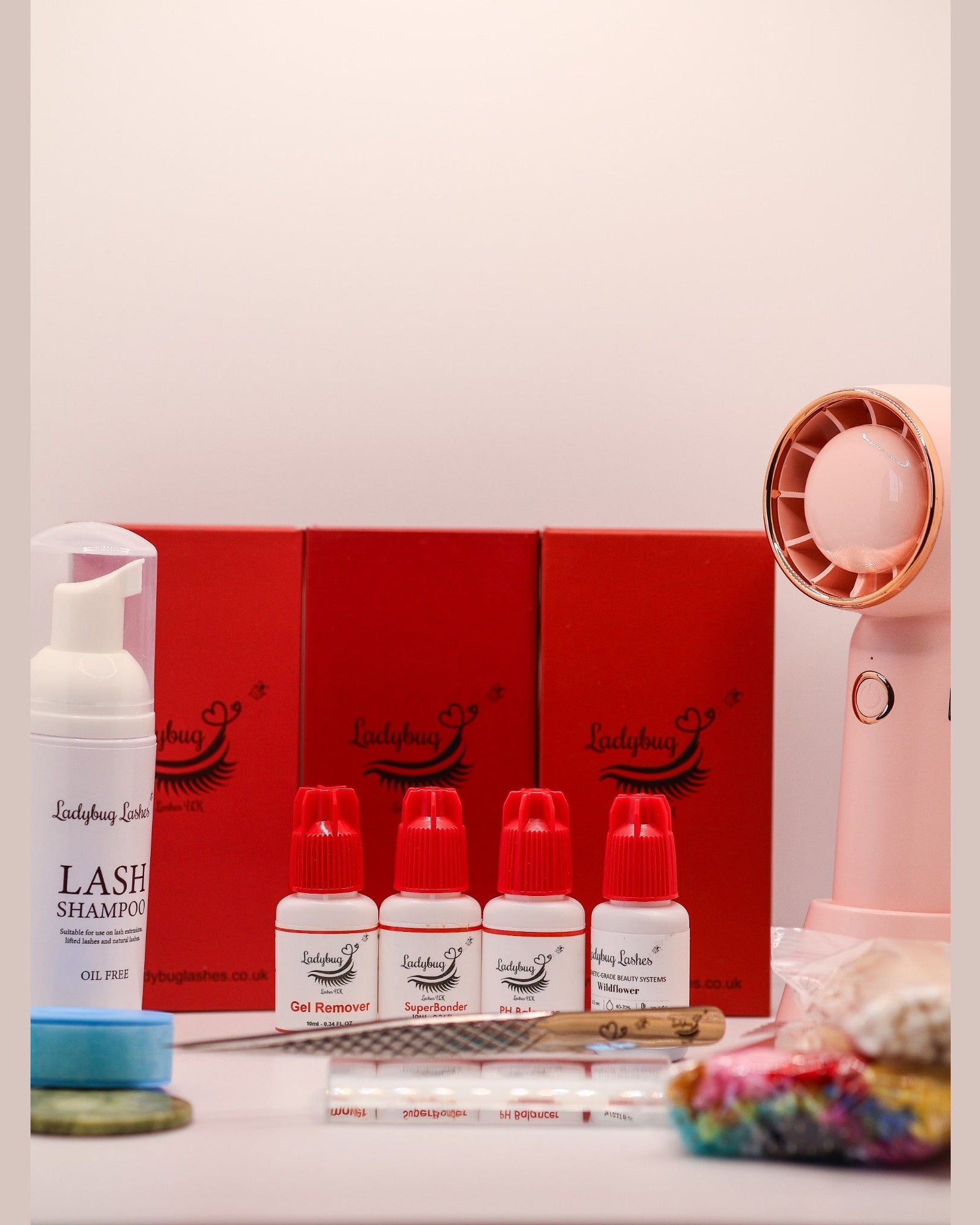
Choosing the right lash tweezers can make a big difference to your comfort, control and application technique.
But there is no single pair of lash tweezers that is best for every lash artist.
Your hand position, grip, technique, the lashes you're working with and even where you naturally hold your tweezers can all affect which shape and tip feel right for you.
Rather than buying every tweezer available, start by understanding what you actually need your tweezers to do.
How Many Lash Tweezers Do You Actually Need?
If you're newly qualified, you do not need a drawer full of tweezers.
A good starting point is:
- One comfortable isolation tweezer
- One application tweezer suited to the technique you're practising
- A reliable spare once you've found a style you like
As your skills develop, you can experiment with different shapes, angles and grip styles.
Buying more tweezers doesn't automatically make application easier.
The aim is to find tools that work with your technique, not collect every shape available.
What Are Isolation Tweezers?
Isolation tweezers are used to separate one natural lash from the surrounding lashes before an extension is attached.
Good isolation is essential for preventing stickies, where neighbouring natural lashes become bonded together.
Common isolation shapes include:
- Straight
- Curved or angled
- Swooped
- Boot-shaped
There is no universal best shape.
Some artists prefer the direct position of a straight isolation tweezer, while others find a curved, angled or boot-shaped design gives them a more comfortable working position.
The important thing is being able to isolate accurately and consistently without fighting against the tool.
What Tweezers Are Best for Classic Lash Extensions?
Classic application requires you to pick up one extension at a time, so control and accurate placement are important.
Straight, curved and angled application tweezers can all work well.
Look for a tweezer that allows you to:
- Pick up the extension cleanly
- Maintain control while dipping into adhesive
- Place the extension accurately
- Release it smoothly
- Work comfortably throughout the appointment
If you're constantly squeezing hard to prevent the extension from moving, the shape, tension or grip style may simply not suit you.
What Tweezers Are Best for Volume Lashes?
Volume tweezers need to securely hold multiple fine fibres while you create, transfer and place your fan.
There are lots of shapes available, including:
- Boot tweezers
- Small Boot tweezers
- Angled Volume tweezers
- 45-degree tweezers
- 60-degree tweezers
- 90-degree tweezers
There isn't one shape that is automatically better.
A wider Boot may give one artist the contact area they want, while another prefers the more focused control of a Small Boot. Some artists find an angled tweezer gives them better visibility, while others prefer a 45°, 60° or 90° working position.
Your fan-making technique matters too.
A tweezer that works beautifully for someone's pinching technique may feel completely wrong to an artist who creates fans on the strip.
Recommendations are useful, but they don't guarantee you'll love the same tweezer.
What Is a Tweezer Sweet Spot?
The sweet spot is the area of the tweezer tip where the two sides meet effectively and provide a reliable grip.
This can be particularly important when creating handmade volume fans.
If you're working outside the best gripping area, you may experience:
- Fans slipping
- Fibres separating during pickup
- Difficulty creating consistent fans
- Having to squeeze harder
- Fans collapsing during transfer
Before deciding a new pair of tweezers isn't right for you, spend some time getting familiar with where and how it grips best.
Even tweezers with similar shapes can feel different in the hand.
Fibre Grip vs Smooth Tip Lash Tweezers
Another choice is whether you prefer Fibre Grip or Smooth Tip tweezers.
Neither is automatically better. They're simply different gripping surfaces.
What Are Fibre Grip Tweezers?
Fibre Grip tweezers have a textured gripping surface designed to create multiple contact points with the lash fibres.
They can provide a strong, secure hold and are particularly popular for handmade volume, premade or promade fans and structured lash styles.
Fibre Grip may suit you if:
- You prefer a stronger textured grip
- You create handmade volume
- You regularly work with premade or promade fans
- You work with structured lashes such as Clover, YY or W Lashes
- You find fibres frequently slip during pickup
- You prefer a larger usable gripping area
Fibre Grip isn't just for beginners. Plenty of experienced artists simply prefer the way it feels.
What Are Smooth Tip Tweezers?
Smooth Tip tweezers have a traditional smooth gripping surface rather than a textured Fibre Grip finish.
They're available in different shapes for isolation, Classic application and Volume work.
Smooth Tip may suit you if:
- You prefer a traditional tweezer feel
- You like smooth pickup and release
- You primarily use your tweezers for isolation or Classic application
- A smooth surface works well with your volume technique
- You're comfortable finding and working within the tweezer's gripping area
Again, neither option wins.
The right grip is the one that gives you consistent control.
Does Tweezer Tension Matter?
Yes.
Some tweezers require more pressure to close than others.
If the tension is too strong for your hand, repeatedly squeezing the tweezer throughout several appointments can become uncomfortable.
If it feels too light for your technique, you may feel you don't have enough control.
Don't judge a tweezer purely by whether you can successfully pick up a lash once.
Consider how it feels after you've been working with it for an extended period.
Why Do My Volume Fans Keep Slipping From My Tweezers?
Don't immediately assume you need another pair.
Check:
- Are you using the best gripping area?
- Are you holding the tweezer at the right angle?
- Are you applying enough pressure?
- Are you applying too much pressure?
- Does the shape suit your fan-making method?
- Would Fibre Grip or Smooth Tip better suit your technique?
- Are the lash fibres themselves affecting pickup?
- Are you trying to pick up too many fibres for your current technique?
Sometimes changing the tweezer helps.
Sometimes changing how you're using it helps.
Do Different Lash Trays Affect Tweezer Pickup?
Yes.
Your tweezers and lash trays work together.
Diameter, fibre, base construction and the type of extension you're using can all affect how the lashes behave during pickup.
You may notice a difference when moving between:
- Classic Lashes
- Handmade Volume Lashes
- Easy Fan Lashes
- Premade or Promade Fans
- Clover Lashes
- YY Lashes
- W Lashes
- Angel Lashes
If a tweezer you've always liked suddenly feels different when you change lash type, don't automatically assume something is wrong with the tweezer.
You may simply need to adjust your pickup position, pressure or technique.
Can Your Choice of Tweezers Affect Hand Comfort?
It can.
Lash artists make thousands of small repetitive movements, so the shape and tension of your tools matter.
Consider whether your tweezers:
- Sit naturally in your hand
- Require excessive squeezing
- Allow a comfortable wrist position
- Give you control without unnecessary tension
A shape that feels comfortable to one artist may feel awkward to another.
If you're regularly experiencing significant hand or wrist discomfort, don't simply work through it. Your posture, working position and repetitive workload should also be considered.
Should Beginners Buy Expensive Lash Tweezers?
You need reliable professional tools, but expensive doesn't automatically mean better for your hand or technique.
When you're starting out, concentrate on finding:
One good isolation tweezer + one good application or fan-making tweezer.
Once you've spent time lashing, you'll understand much more about your natural grip, preferred working angle and the amount of tension you like.
You'll then be in a much better position to decide whether another shape would actually benefit you.
It also avoids one of the easiest mistakes to make when you're newly qualified:
buying absolutely everything before you know what you actually enjoy using.
How Do You Know You've Found the Right Lash Tweezers?
The right tweezers should feel comfortable and predictable while you're working.
You should be able to:
- Pick up lashes reliably
- Maintain control
- Isolate accurately
- Release lashes cleanly
- Work without excessive squeezing
- Repeat your technique consistently
You shouldn't have to constantly think about what the tweezer is doing.
And struggling with a technique doesn't automatically mean you need another pair of tweezers.
Sometimes the answer really is simply practice.
The Bottom Line
There isn't one perfect lash tweezer for every lash artist.
Straight or curved. Boot or angled. Fibre Grip or Smooth Tip. Your technique, hand position, grip, fan-making method and the lashes you're working with all influence which combination will suit you.
Start simple. Find a comfortable isolation tweezer and an application or volume tweezer suited to the technique you're learning.
Then practise with them.
As your skills develop, your preferences probably will too.
The best lash tweezers aren't necessarily the most expensive, the newest or the ones another artist swears by. They're the ones that give you reliable control and feel right in your hand.
Ready to Compare Your Options?
Explore our Professional Lash & Brow Tweezers collection to compare different isolation, Classic, Volume, Fibre Grip and Smooth Tip styles and choose the tools that best suit the way you work.
'%3e%3cg id='Final-Copy-2_2_' transform='translate(1275.000000, 200.000000)'%3e%3cpath class='st0' d='M7.4,12.8h6.8l3.1-11.6H7.4C4.2,1.2,1.6,3.8,1.6,7S4.2,12.8,7.4,12.8z'/%3e%3c/g%3e%3c/g%3e%3c/g%3e%3cg id='final---dec.11-2020'%3e%3cg id='_x30_208-our-toggle' transform='translate(-1275.000000, -200.000000)'%3e%3cg id='Final-Copy-2' transform='translate(1275.000000, 200.000000)'%3e%3cpath class='st1' d='M22.6,0H7.4c-3.9,0-7,3.1-7,7s3.1,7,7,7h15.2c3.9,0,7-3.1,7-7S26.4,0,22.6,0z M1.6,7c0-3.2,2.6-5.8,5.8-5.8 h9.9l-3.1,11.6H7.4C4.2,12.8,1.6,10.2,1.6,7z'/%3e%3cpath id='x' class='st2' d='M24.6,4c0.2,0.2,0.2,0.6,0,0.8l0,0L22.5,7l2.2,2.2c0.2,0.2,0.2,0.6,0,0.8c-0.2,0.2-0.6,0.2-0.8,0 l0,0l-2.2-2.2L19.5,10c-0.2,0.2-0.6,0.2-0.8,0c-0.2-0.2-0.2-0.6,0-0.8l0,0L20.8,7l-2.2-2.2c-0.2-0.2-0.2-0.6,0-0.8 c0.2-0.2,0.6-0.2,0.8,0l0,0l2.2,2.2L23.8,4C24,3.8,24.4,3.8,24.6,4z'/%3e%3cpath id='y' class='st3' d='M12.7,4.1c0.2,0.2,0.3,0.6,0.1,0.8l0,0L8.6,9.8C8.5,9.9,8.4,10,8.3,10c-0.2,0.1-0.5,0.1-0.7-0.1l0,0 L5.4,7.7c-0.2-0.2-0.2-0.6,0-0.8c0.2-0.2,0.6-0.2,0.8,0l0,0L8,8.6l3.8-4.5C12,3.9,12.4,3.9,12.7,4.1z'/%3e%3c/g%3e%3c/g%3e%3c/g%3e%3c/g%3e%3c/svg%3e) Your Privacy Choices
Your Privacy Choices