The term “cosmetic grade” is widely used within the lash industry, but it is also widely misunderstood.
Many lash artists assume that if an adhesive is being sold specifically for eyelash extensions, it must automatically have been developed to cosmetic standards and with repeated professional use around the eye area in mind.
That should not simply be assumed.
At the same time, the words “cosmetic grade” are not, by themselves, proof that an adhesive is safer, gentler or incapable of causing an allergic reaction.
So what does cosmetic grade actually mean when we're talking about professional lash adhesives?
Is “Cosmetic Grade” an Official Legal Classification?
There isn't a legally defined category of lash adhesive called “cosmetic grade” that automatically guarantees the quality or safety of a product.
Within the professional lash industry, the term is generally used to describe an approach to formulation and manufacturing where cosmetic use, ingredient suitability, quality control, regulatory requirements and professional application around the eye area have been considered.
However, simply putting “cosmetic grade” on a product description isn't enough.
Lash artists should look beyond the marketing term and consider the finished formulation, intended use, manufacturing standards, supporting documentation and transparency of the supplier.
Not All Cyanoacrylate Adhesives Are the Same
Cyanoacrylate is not exclusive to the lash industry.
Different forms and formulations of cyanoacrylate chemistry are used across cosmetic, medical, household and industrial applications.
That doesn't mean a professional lash adhesive and a household adhesive are the same product simply because both contain a type of cyanoacrylate.
The complete formulation matters.
Different products can contain different grades of raw materials, stabilising systems, pigments, polymers and other ingredients depending on what the finished product has been designed to do.
So the important question isn't simply:
“Does it contain cyanoacrylate?”
It is:
“Has this finished formulation been appropriately developed, assessed and supplied for its intended professional cosmetic use?”
What About Lash Adhesives Adapted From Other Applications?
This is where the conversation becomes more complicated.
Changing the viscosity, colour or curing behaviour of an adhesive can change how it performs, but those changes alone do not tell you whether the finished formulation is appropriate for professional cosmetic use around the eye area.
Rather than trying to determine what an adhesive formulation may originally have been developed for, lash artists are better served by looking at what can actually be established about the finished product.
Who manufactured it?
What is its intended use?
What ingredients does it contain?
What safety and compliance processes support it?
Is the supplier transparent about the product they are selling?
These questions tell you considerably more than a marketing phrase on the front of a bottle.
What Should Lash Artists Look For?
If a supplier describes its lash adhesive as cosmetic grade, don't be afraid to look deeper.
Consider:
- Whether the product has a clearly stated intended use
- Ingredient transparency
- Appropriate safety and regulatory documentation
- Manufacturing and quality-control standards
- Batch traceability
- Clear instructions and warnings
- Whether the supplier can answer reasonable questions about the formulation and compliance of its products
Transparency matters more than simply using the words “cosmetic grade”.
Why Do Lash Adhesive Formulations Differ?
Two lash adhesives can have similar advertised curing speeds and still behave very differently.
The complete formulation can influence characteristics such as:
- Viscosity
- Curing behaviour
- Flexibility
- Fume intensity
- Shelf life
- Stability
- Performance under different environmental conditions
This is why two adhesives both advertised as “one-second glues” may not feel or perform exactly the same.
Curing speed alone tells you very little about the complete formulation.
What About Stabilisers and Additional Ingredients?
Cyanoacrylate formulations require careful control to remain stable inside the bottle while still polymerising when used.
The stabilising system and other ingredients used within an adhesive therefore matter.
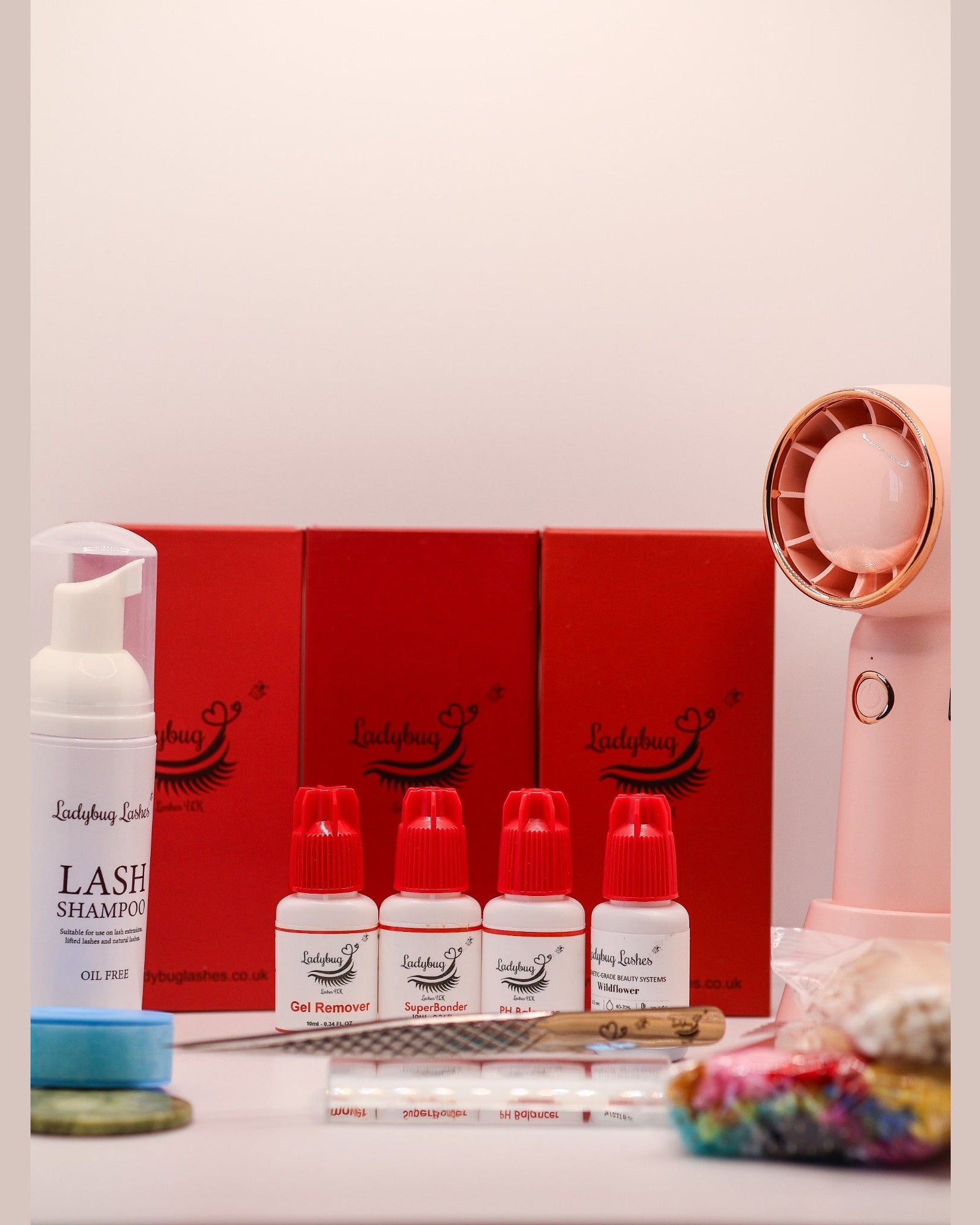
At Ladybug Lashes, this is one of the reasons we place such importance on ingredient transparency.
Rather than assuming that every lash adhesive has essentially the same formulation, professionals should understand that the additional ingredients and formulation approach can differ between products.
Being able to see what is actually in the adhesive allows lash artists to make a more informed product choice.
Does Cosmetic Grade Mean Allergy-Free?
No.
This is extremely important.
A cosmetic-grade lash adhesive can still cause irritation or allergic sensitisation.
Professional lash adhesives commonly rely on cyanoacrylate chemistry, and describing an adhesive as cosmetic grade should never be interpreted as meaning that a client or lash artist cannot react to it.
Likewise, terms such as “sensitive” should not be treated as a guarantee that an adhesive cannot cause an allergic reaction.
Once somebody has developed an allergy or sensitisation, simply changing to another adhesive should not automatically be assumed to solve the problem.
Why Overall Exposure Matters
Adhesive also shouldn't be considered in isolation.
During a lash treatment, a client may be exposed to:
- Lash shampoo
- Primer or preparation products
- Adhesive
- Tape
- Under-eye pads
- Retention products
- Bonder
- Remover
Lash professionals may work with these products repeatedly throughout the working day.
This is why our approach is not simply about finding one ingredient and labelling it “good” or “bad”.
We believe in considering the whole treatment system and unnecessary exposure wherever reasonably possible.
Does a Higher Price Mean a Better Lash Adhesive?
Not necessarily.
Price alone cannot prove the quality of a formulation.
However, manufacturing standards, ingredient sourcing, testing, regulatory work, documentation, quality control and batch management all carry costs.
Rather than assuming that the cheapest adhesive is poor or the most expensive is automatically superior, look at what sits behind the product.
A professional supplier should be able to provide meaningful information about what they are selling.
Why Ladybug Lashes Takes a Cosmetic-First Approach
At Ladybug Lashes, our approach is to develop professional liquids with cosmetic use at the centre of the formulation and manufacturing process.
For us, cosmetic grade isn't simply wording added to a product page.
Our focus is on:
- Appropriate cosmetic manufacturing
- Ingredient transparency
- Controlled formulations
- Product safety and compliance
- Batch traceability
- Clear professional guidance
- Avoiding unnecessary ingredients and exposure where reasonably possible
We also believe lash artists deserve to understand what they're actually working with.
That's why education around ingredients, stabilisers, adhesive behaviour and professional use forms such a large part of what we do.
Is Cosmetic Grade the Only Thing That Matters?
No.
A well-formulated adhesive can still perform poorly if it isn't appropriate for the lash artist's working speed, technique or environment.
Likewise, even an excellent adhesive cannot compensate for incorrect placement, unsuitable preparation or poor application technique.
Product quality and professional technique need to work together.
When choosing an adhesive, consider:
Formulation + transparency + professional suitability + your working speed + your environment + correct technique.
Not simply the claims printed on the bottle.
The Bottom Line
“Cosmetic grade” is not a magic phrase that automatically proves a lash adhesive is safer or better.
What matters is what sits behind the claim.
Look at the finished formulation, intended use, manufacturing standards, ingredient transparency, documentation and the supplier's willingness to answer questions about their products.
And remember that cosmetic grade does not mean allergy-free.
At Ladybug Lashes, our cosmetic-first approach is about making informed formulation choices, maintaining transparency and considering professional use around the eye area from the beginning - rather than relying on a marketing phrase alone.
For lash artists, the best approach is simple:
Don't just read the claim. Understand the product behind it.