
You do not automatically need a different lash adhesive just because the season changes. What matters is whether the temperature and humidity inside your lash room change enough to affect how your adhesive behaves.
A hygrometer will tell you far more than the weather forecast.
Why Can Lash Glue Feel Different in Summer and Winter?
Cyanoacrylate lash adhesive cures using moisture in the air.
As a general rule:
- higher humidity can speed up curing
- lower humidity can slow curing
Temperature can also influence adhesive behaviour.
That means the same bottle can feel faster in one environment and slower in another.
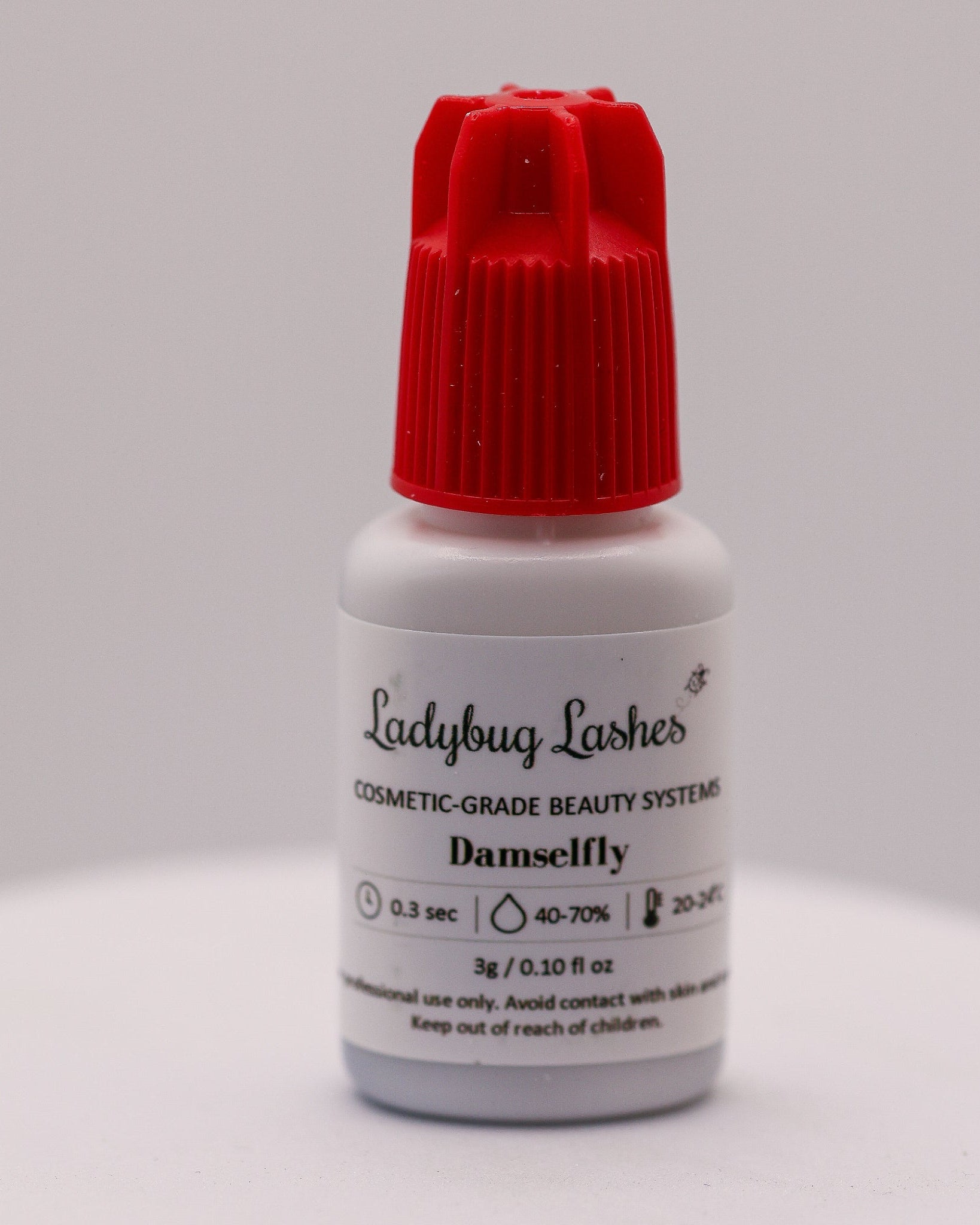
At Ladybug Lashes, our general recommended working conditions are approximately 20–24°C and 40–70% relative humidity, with around 55% RH being a comfortable point for many artists.
Summer Lash Glue Problems
Summer does not automatically mean high humidity, but many lash rooms become warmer or more humid during hot weather.
If your humidity rises, you may notice:
- your adhesive grabbing faster
- less placement time
- extensions popping off if the glue begins setting before attachment is complete
- your usual adhesive suddenly feeling quicker than normal
If your room consistently sits towards the higher end of your normal humidity range, a slightly slower adhesive may feel easier to control. Meadow or Spring may be worth considering depending on your placement speed.
That does not mean everyone needs a special “summer glue”.
Winter Lash Glue Problems
Heating can make indoor air much drier during winter.
Lower humidity can slow cyanoacrylate curing, which may result in:
- extensions moving after placement
- fans closing
- more stickies
- waiting longer for the adhesive to grab
If your treatment room regularly becomes much drier in winter, a faster adhesive may feel more comfortable. Depending on your working speed, that could mean Wildflower or, for very fast placement, Damselfly.
Again, the important factor is your actual room conditions — not simply the month of the year.
Use a Hygrometer Before Changing Your Glue
Every lash artist working with cyanoacrylate adhesive should have a hygrometer in their treatment room.
A hygrometer measures relative humidity, and most also show temperature.
If your normally reliable glue suddenly feels different, check the hygrometer before assuming something is wrong with the adhesive.
Your environment may simply have changed.
For more detail, read how temperature and humidity affect lash glue.
Should You Control the Room or Change the Adhesive?
Where possible, maintaining a reasonably stable treatment-room environment is usually the simplest approach.
Heating, air conditioning, ventilation, humidifiers or dehumidifiers can all influence your room conditions.
But not every salon has complete environmental control.
If your room naturally sits at very different humidity levels throughout the year, choosing an adhesive speed that better suits those conditions can make application easier.
Higher humidity: you may prefer a slightly slower adhesive
Lower humidity: you may prefer a slightly faster adhesive
Your placement speed still comes first. Humidity helps you fine-tune the choice.
Try a Sample Before Switching Adhesives
If the seasons change and your usual adhesive suddenly feels less comfortable, you do not have to commit to another full bottle immediately.
Our 1g cosmetic-grade lash adhesive samples allow you to test another speed in your own treatment room first.
That means you can see how it behaves with your:
- placement speed
- normal temperature and humidity
- lash techniques
- everyday salon routine
It is a much better test than choosing an adhesive simply because it has been marketed as a “summer” or “winter” glue.
Do You Need Two Lash Glues?
Some artists do keep different speeds available because their room conditions change significantly throughout the year.
Others use the same adhesive all year because their salon environment remains fairly stable.
Both approaches can work.
There is no rule saying you need separate summer and winter lash glues.
The Bottom Line
Do not choose your adhesive according to the season alone.
Choose it according to your placement speed and the actual temperature and humidity in your lash room.
If your humidity rises considerably, a slightly slower adhesive may suit you better. If your environment becomes much drier, a faster option may feel more comfortable.
Use a hygrometer, watch how your adhesive behaves and make decisions based on your real working conditions rather than the weather outside.
If you are still deciding which speed suits you, our guide to lash glue drying times explains the difference between 0.3, 0.5–1, 1 and 1–2 second adhesives.
'%3e%3cg id='Final-Copy-2_2_' transform='translate(1275.000000, 200.000000)'%3e%3cpath class='st0' d='M7.4,12.8h6.8l3.1-11.6H7.4C4.2,1.2,1.6,3.8,1.6,7S4.2,12.8,7.4,12.8z'/%3e%3c/g%3e%3c/g%3e%3c/g%3e%3cg id='final---dec.11-2020'%3e%3cg id='_x30_208-our-toggle' transform='translate(-1275.000000, -200.000000)'%3e%3cg id='Final-Copy-2' transform='translate(1275.000000, 200.000000)'%3e%3cpath class='st1' d='M22.6,0H7.4c-3.9,0-7,3.1-7,7s3.1,7,7,7h15.2c3.9,0,7-3.1,7-7S26.4,0,22.6,0z M1.6,7c0-3.2,2.6-5.8,5.8-5.8 h9.9l-3.1,11.6H7.4C4.2,12.8,1.6,10.2,1.6,7z'/%3e%3cpath id='x' class='st2' d='M24.6,4c0.2,0.2,0.2,0.6,0,0.8l0,0L22.5,7l2.2,2.2c0.2,0.2,0.2,0.6,0,0.8c-0.2,0.2-0.6,0.2-0.8,0 l0,0l-2.2-2.2L19.5,10c-0.2,0.2-0.6,0.2-0.8,0c-0.2-0.2-0.2-0.6,0-0.8l0,0L20.8,7l-2.2-2.2c-0.2-0.2-0.2-0.6,0-0.8 c0.2-0.2,0.6-0.2,0.8,0l0,0l2.2,2.2L23.8,4C24,3.8,24.4,3.8,24.6,4z'/%3e%3cpath id='y' class='st3' d='M12.7,4.1c0.2,0.2,0.3,0.6,0.1,0.8l0,0L8.6,9.8C8.5,9.9,8.4,10,8.3,10c-0.2,0.1-0.5,0.1-0.7-0.1l0,0 L5.4,7.7c-0.2-0.2-0.2-0.6,0-0.8c0.2-0.2,0.6-0.2,0.8,0l0,0L8,8.6l3.8-4.5C12,3.9,12.4,3.9,12.7,4.1z'/%3e%3c/g%3e%3c/g%3e%3c/g%3e%3c/g%3e%3c/svg%3e) Your Privacy Choices
Your Privacy Choices