
If you've ever been told that clear lash adhesive is better for sensitive clients because it doesn't contain carbon black, you're not alone.
Clear lash adhesives are sometimes described as being "gentler", "lower fume" or a better choice for clients who have previously reacted to eyelash extension adhesive.
But is that actually what makes an adhesive clear?
And, more importantly, does removing the black pigment make an eyelash adhesive suitable for someone with an adhesive allergy?
Not necessarily.
To understand why, we need to look beyond the colour of the adhesive and consider what is actually inside the formulation.
What Makes Lash Adhesive Black?
Most traditional black eyelash extension adhesives contain a pigment to give them their black colour.
One commonly used pigment is Carbon Black (CI 77266).
Its purpose within the formulation is primarily colour. It creates the dark adhesive attachment lash artists are familiar with and helps the adhesive blend into black lash extensions.
A clear adhesive simply doesn't contain the black pigment used to create that colour.
But removing a pigment doesn't automatically change the fundamental adhesive chemistry.
What Is Actually Inside Lash Adhesive?
Professional eyelash extension adhesives are complete formulations containing several ingredients, each with a different purpose.
The main bonding ingredient is typically a cyanoacrylate, which polymerises in the presence of moisture to create the bond between the natural lash and extension.
But cyanoacrylate isn't the only ingredient that matters.
Depending on the formulation, an adhesive may also contain:
Stabilisers – used to help control and stabilise the cyanoacrylate within the formulation and support shelf life and performance.
Pigments – such as Carbon Black (CI 77266), which may be added to create a black adhesive.
Other formulation ingredients – which can vary considerably between one adhesive and another.
Not every lash adhesive uses the same stabiliser system. Ingredients such as hydroquinone (HQ) may be used as stabilisers in some cyanoacrylate adhesives, while other formulations use alternative stabilising systems.
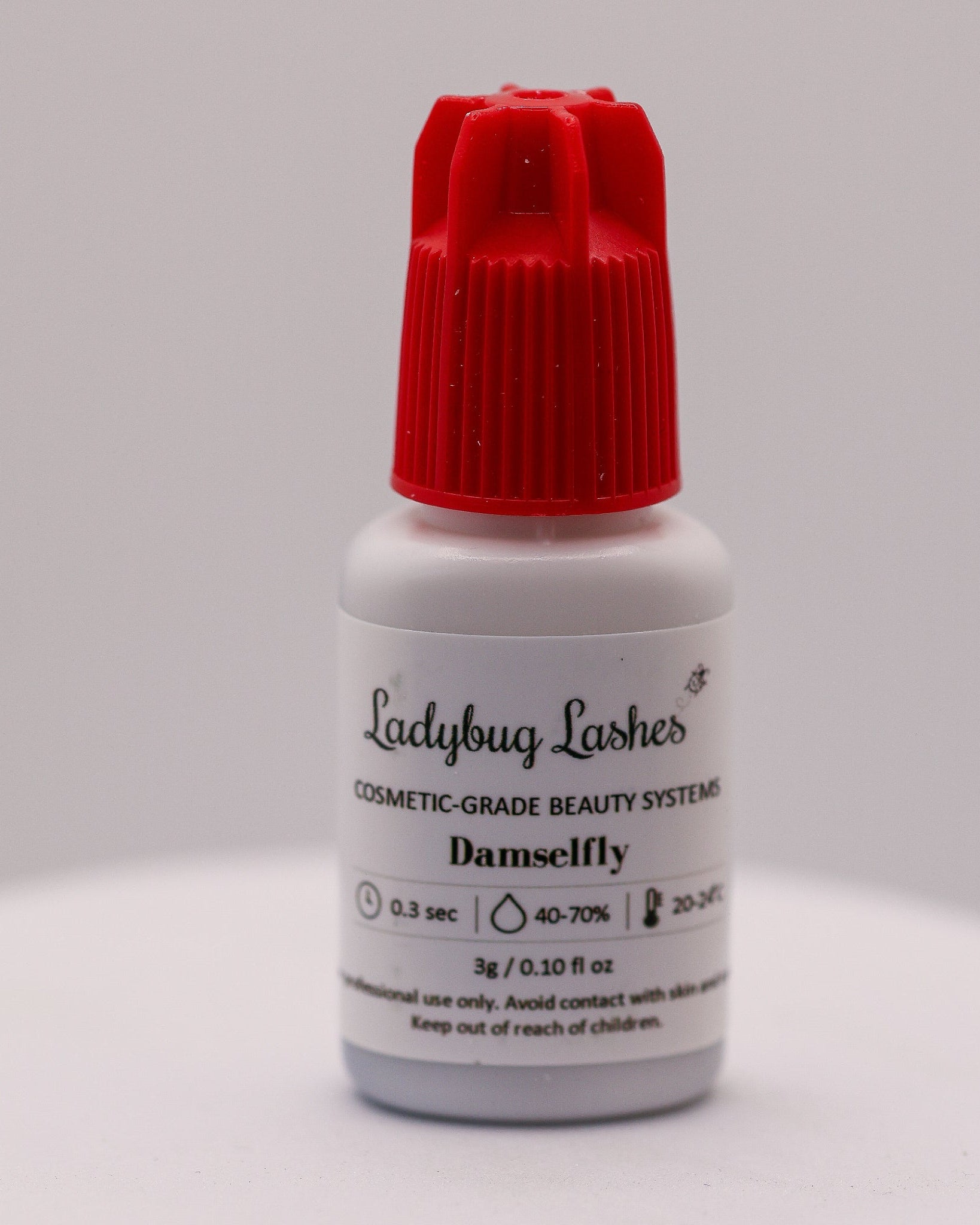
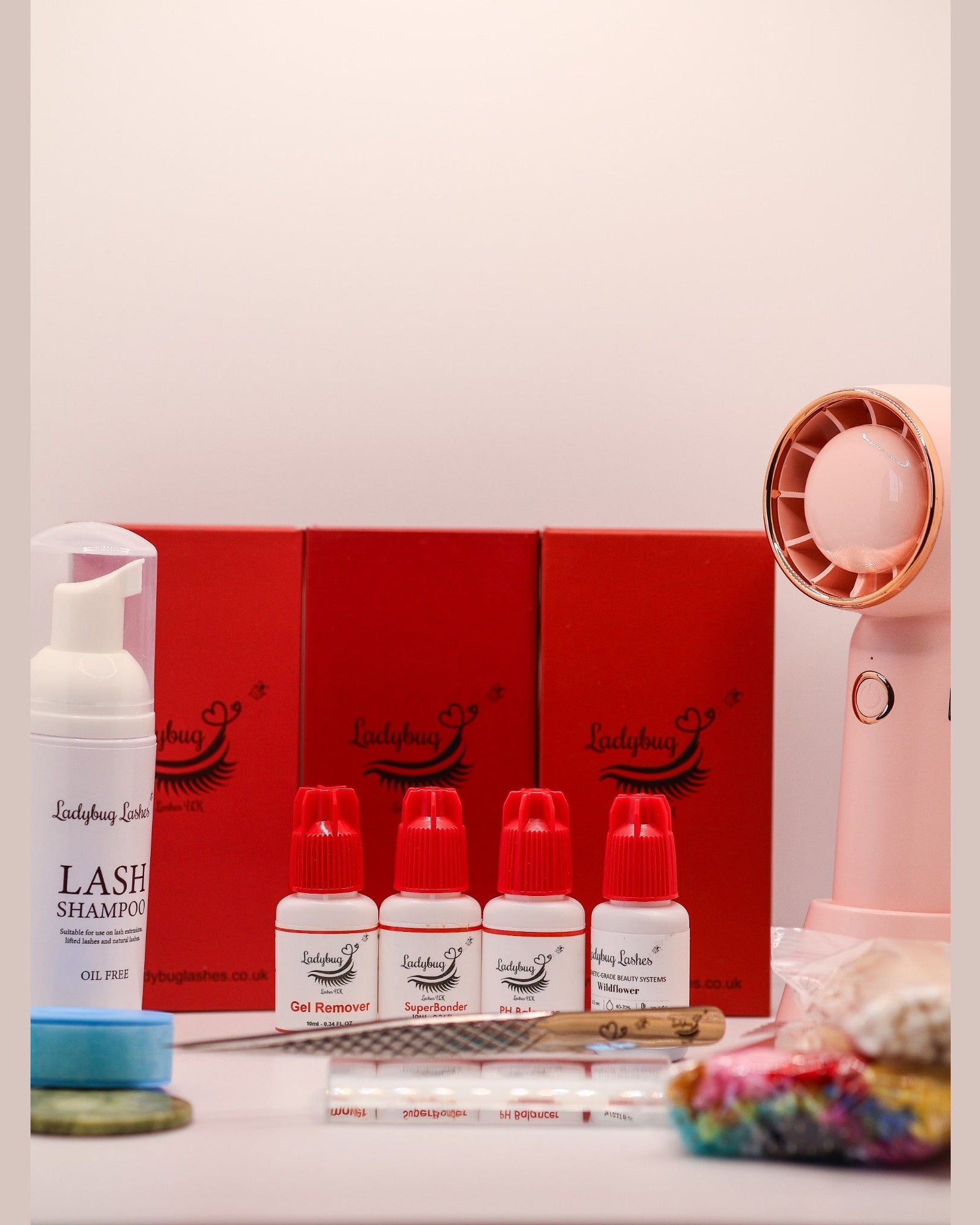
At Ladybug Lashes, for example, our cosmetic-grade cyanoacrylate adhesives use a BHA stabiliser system rather than hydroquinone (HQ).
Removing carbon black therefore tells you one thing about an adhesive.
It doesn't tell you which cyanoacrylate is being used, which stabiliser system the formulation contains, what other ingredients are present or which ingredient may have contributed to a previous reaction.
Is Carbon Black a Common Lash Adhesive Allergen?
This is where the evidence becomes particularly interesting.
Carbon black isn't unique to eyelash adhesive. CI 77266 is also used as a black pigment in cosmetic products, including products used around the eyes.
More importantly, published dermatological literature does not support treating carbon black as a common skin sensitiser.
A comprehensive 2023 review of contact allergy to cosmetic pigments concluded that carbon black is not considered a skin sensitiser.
Read the 2023 Contact Dermatitis review on PubMed
By contrast, allergic contact dermatitis associated with cyanoacrylate-containing eyelash adhesive is documented in medical literature.
Published report on ethyl cyanoacrylate allergy from eyelash adhesive
That does not mean that an individual could never be sensitive to a pigment or another ingredient in a particular formulation.
What it does mean is that automatically assuming:
black adhesive + reaction = carbon black allergy
isn't supported by the evidence.
The colour of an adhesive cannot identify which ingredient was responsible for a suspected allergic reaction.
What If the Client Wears Black Mascara or Eyeliner?
This raises another useful question.
Carbon black is used as a pigment in various cosmetic products, including some mascaras and eyeliners.
If carbon black itself were suspected of being responsible for a client's reaction, their history of exposure to other products containing that ingredient may therefore be relevant.
For example, have they regularly used cosmetics containing CI 77266 without experiencing problems?
However, this cannot be used to rule out an allergy.
Different products contain different concentrations and formulations and are used under different exposure conditions.
Tolerating a mascara containing carbon black doesn't conclusively prove that carbon black could not be involved in another reaction.
Equally, reacting after wearing black lash adhesive certainly doesn't prove that carbon black was responsible.
That's why the actual allergen shouldn't be diagnosed based simply on the colour of the adhesive.
Does the Quality of the Cyanoacrylate Matter?
Yes - but not because higher-quality cyanoacrylate becomes allergy-free.
Cyanoacrylate is a reactive monomer, and the quality and purity of the raw material used within an adhesive matters.
Purification, filtration and appropriate manufacturing controls can help reduce unwanted impurities and provide greater control over what is present within the finished formulation.
This distinction is important.
Higher purity doesn't remove the inherent sensitisation potential of cyanoacrylate itself.
Published patch-testing research has used highly purified cyanoacrylate when investigating cyanoacrylate allergy, demonstrating why purity and allergenic potential are two separate issues.
So when we're evaluating an adhesive formulation, there is a considerable difference between asking:
“Does it contain carbon black?”
and asking:
“What is the quality of the entire formulation?”
Considerations can include:
- the type of cyanoacrylate used
- the quality and purity of the raw material
- purification and processing
- the stabiliser system
- other formulation ingredients
- manufacturing controls
- safety assessment of the finished product
Removing carbon black doesn't tell you any of those things.
We've explored this in more detail in our guide to what professional lash adhesive is actually made from:
What Is Lash Glue Made From? – Ladybug Lashes
Is Clear Lash Glue Hypoallergenic?
No. Clear does not mean hypoallergenic.
Removing carbon black does not automatically remove ingredients capable of causing irritation or sensitisation.
A clear adhesive can still contain cyanoacrylate.
It will also have its own complete formulation, which may include a stabiliser system and other ingredients.
It should therefore not be presented as an allergy-free alternative simply because it doesn't contain black pigment.
Likewise, terms such as "sensitive glue" can be misleading if they're interpreted to mean an allergic reaction cannot occur.
No professional eyelash extension adhesive should be assumed to be allergy-proof.
Can Someone With a Lash Glue Allergy Use Clear Adhesive?
If a client has experienced a suspected allergic reaction to eyelash extension adhesive, switching from black adhesive to clear adhesive should not automatically be presented as a safe solution.
If both adhesives contain cyanoacrylate, removing the black pigment hasn't removed exposure to the cyanoacrylate.
The clear adhesive may also contain the same or a different stabiliser system and other formulation ingredients, all of which need to be considered when comparing the two products.
Simply removing carbon black therefore doesn't tell us whether a client will or won't react to the alternative formulation.
Symptoms following an appointment can have different causes, so lash artists should avoid diagnosing the responsible ingredient themselves or promising that another adhesive will prevent a reaction.
Where there has been a suspected allergic reaction, it should be taken seriously rather than simply experimenting with different adhesives on the client.
Does Clear Lash Glue Have Fewer Fumes?
Not simply because it's clear.
The colour of an adhesive does not, by itself, tell you how much cyanoacrylate vapour it produces.
Two adhesives can contain different cyanoacrylates, stabiliser systems and overall formulations regardless of whether they're clear or black.
An individual clear adhesive may behave differently from an individual black adhesive because the formulations are different.
But you cannot conclude:
clear = fewer fumes
or
black = more fumes
simply because one contains black pigment.
The overall formulation matters.
Allergy vs Irritation: They're Not the Same Thing
The words allergy, sensitivity and irritation are often used interchangeably within the lash industry, but they don't necessarily describe the same thing.
Temporary irritation may be associated with factors surrounding the treatment and exposure during application.
An allergic reaction involves an immune response.
For example, discomfort during or immediately following an appointment does not automatically prove that a client is "allergic to carbon black".
Equally, a client who has previously experienced a suspected adhesive allergy shouldn't simply be labelled as having "sensitive eyes" and moved onto a clear adhesive.
The distinction matters.
Why Might One Lash Adhesive Feel More Comfortable Than Another?
Because lash adhesives are complete formulations - not simply cyanoacrylate with or without black pigment.
The cyanoacrylate used, its purity, the stabiliser system, pigments and other formulation ingredients can all differ between products.
This is why choosing the right lash adhesive isn't simply about whether an adhesive is clear or black. Cure speed, formulation, working conditions and the individual lash artist's technique all need to be considered.
Application technique and treatment conditions matter too.
Correct extension placement, appropriate adhesive quantity, suitable temperature and humidity, ventilation and professional application can all influence the treatment experience.
So it's entirely possible for someone to report a different experience with two adhesives.
What we shouldn't do is automatically attribute that difference to carbon black simply because one adhesive happens to be clear.
What Is Clear Lash Adhesive Actually For?
Clear lash adhesive can be incredibly useful.
It's particularly popular for:
Coloured lash extensions – where a black attachment may be visible.
Creative lash sets – especially when working with bright or pale colours.
Brown lash extensions – depending on the desired finish.
Artists who prefer clear adhesive – whether aesthetically or because they prefer the performance of a particular formulation.
There are plenty of legitimate reasons to choose a clear adhesive.
Being an automatic solution for adhesive allergy isn't one of them.
Clear vs Black Lash Adhesive: The Bottom Line
The difference between clear and black adhesive is easy to oversimplify.
A black adhesive may contain carbon black or another pigment to create its colour.
A clear adhesive doesn't require that black pigment.
But that does not automatically mean the clear adhesive:
- is hypoallergenic
- is suitable for clients with adhesive allergies
- produces fewer fumes
- cannot cause irritation
- is safer for sensitive eyes
And the available evidence doesn't support automatically treating carbon black as the culprit when somebody reacts following an eyelash extension treatment.
Looking only at whether an adhesive contains carbon black tells you very little about the rest of its formulation.
The cyanoacrylate, its quality and purity, stabiliser system, other ingredients and complete finished formulation matter too.
Clear lash adhesive is a colour and formulation choice - not an allergy solution.
For lash artists, accurate education around adhesive chemistry is particularly important because clients rely on professionals to distinguish between evidence and marketing claims.
At Ladybug Lashes, that's exactly what we believe professional education should do.
Built on evidence. Not marketing.
'%3e%3cg id='Final-Copy-2_2_' transform='translate(1275.000000, 200.000000)'%3e%3cpath class='st0' d='M7.4,12.8h6.8l3.1-11.6H7.4C4.2,1.2,1.6,3.8,1.6,7S4.2,12.8,7.4,12.8z'/%3e%3c/g%3e%3c/g%3e%3c/g%3e%3cg id='final---dec.11-2020'%3e%3cg id='_x30_208-our-toggle' transform='translate(-1275.000000, -200.000000)'%3e%3cg id='Final-Copy-2' transform='translate(1275.000000, 200.000000)'%3e%3cpath class='st1' d='M22.6,0H7.4c-3.9,0-7,3.1-7,7s3.1,7,7,7h15.2c3.9,0,7-3.1,7-7S26.4,0,22.6,0z M1.6,7c0-3.2,2.6-5.8,5.8-5.8 h9.9l-3.1,11.6H7.4C4.2,12.8,1.6,10.2,1.6,7z'/%3e%3cpath id='x' class='st2' d='M24.6,4c0.2,0.2,0.2,0.6,0,0.8l0,0L22.5,7l2.2,2.2c0.2,0.2,0.2,0.6,0,0.8c-0.2,0.2-0.6,0.2-0.8,0 l0,0l-2.2-2.2L19.5,10c-0.2,0.2-0.6,0.2-0.8,0c-0.2-0.2-0.2-0.6,0-0.8l0,0L20.8,7l-2.2-2.2c-0.2-0.2-0.2-0.6,0-0.8 c0.2-0.2,0.6-0.2,0.8,0l0,0l2.2,2.2L23.8,4C24,3.8,24.4,3.8,24.6,4z'/%3e%3cpath id='y' class='st3' d='M12.7,4.1c0.2,0.2,0.3,0.6,0.1,0.8l0,0L8.6,9.8C8.5,9.9,8.4,10,8.3,10c-0.2,0.1-0.5,0.1-0.7-0.1l0,0 L5.4,7.7c-0.2-0.2-0.2-0.6,0-0.8c0.2-0.2,0.6-0.2,0.8,0l0,0L8,8.6l3.8-4.5C12,3.9,12.4,3.9,12.7,4.1z'/%3e%3c/g%3e%3c/g%3e%3c/g%3e%3c/g%3e%3c/svg%3e) Your Privacy Choices
Your Privacy Choices