
Have you ever looked at a Safety Data Sheet for a lash adhesive and wondered what all those chemical names, CAS numbers and percentages actually mean?
Does a table that adds up to 100% mean you’ve been shown every ingredient? What does each ingredient actually do? And why can an ingredient present at less than 0.1% still play an important role?
You don’t need to be a chemist to understand the basics.
In this guide, we’ll show you how to read the composition information on a lash adhesive SDS, what the ingredients actually do and why the percentages may not tell the whole story.
First: An SDS Is Not a Recipe
A Safety Data Sheet, or SDS, is a safety document.
It provides important information about a chemical product, including its hazards, safe handling, storage, exposure controls, stability and what to do in an emergency. HSE describes SDSs as important documents for the safe supply, handling and use of chemicals in the workplace.
But an SDS is not necessarily a complete manufacturing formula.
For mixtures, Section 3 requires certain substances to be identified according to the applicable criteria. Suppliers can also choose to list additional substances, including ones that don't meet the criteria for classification.
So don't automatically read Section 3 and think:
“These are every ingredient in the bottle.”
A better way to think about it is:
“This is the composition information being disclosed on this safety document.”
That distinction is really important.
Where Do I Find the Ingredients?
On a standard SDS, look for:
Section 3 – Composition / Information on Ingredients
This is where you'll usually find information such as:
- Chemical or ingredient name
- CAS number
- EC number
- Concentration or concentration range
- Hazard classification
Concentrations can be given as exact percentages or percentage ranges.
And that's our first clue that an SDS shouldn't be read like a recipe.
What Is a CAS Number?
A CAS number is a unique identifier for a chemical substance.
This is useful because the same chemical can sometimes be known by different names.
Think of it as a way of checking:
“Which chemical are we actually talking about?”
Rather than relying only on the ingredient name, the CAS number can help you identify the actual substance being referenced.
Should the Ingredients Add Up to 100%?
Not necessarily.
Section 3 doesn't necessarily disclose every ingredient in a mixture.
Some ingredients may not meet the criteria requiring them to be individually listed, while concentrations that are disclosed may be expressed as ranges rather than exact formulation percentages.
So if the ingredients on an SDS don't add up to 100%, that doesn't automatically mean something is missing incorrectly.
You're reading a safety document - not a recipe.
But What If They Add Up to Exactly 100%?
This is where you need to look a little more carefully.
Imagine an SDS lists:
Ingredient A – 95%
Ingredient B – 4.5%
Ingredient C – 0.5%
That gives you exactly 100%.
If those are genuinely exact percentages of the finished mixture, mathematically those three ingredients account for the whole mixture.
But remember what we've just learned: Section 3 doesn't necessarily have to list every component in a mixture.
There may be other formulation components that don't meet the criteria requiring them to be individually disclosed in Section 3.
And if other ingredients are present, there still has to be room for them within the actual 100% formulation.
So three substances cannot genuinely represent exact concentrations of 95% + 4.5% + 0.5% of the finished product while additional ingredients are also present.
That's why a perfectly neat 100% total shouldn't automatically make you think:
“Great - that's the complete recipe.”
Instead, look at whether you're being given exact concentrations, ranges or limits, what substances have actually been disclosed and what those substances do.
If something doesn't make sense, ask the supplier for clarification.
An SDS is a safety document - but the maths still has to make sense.
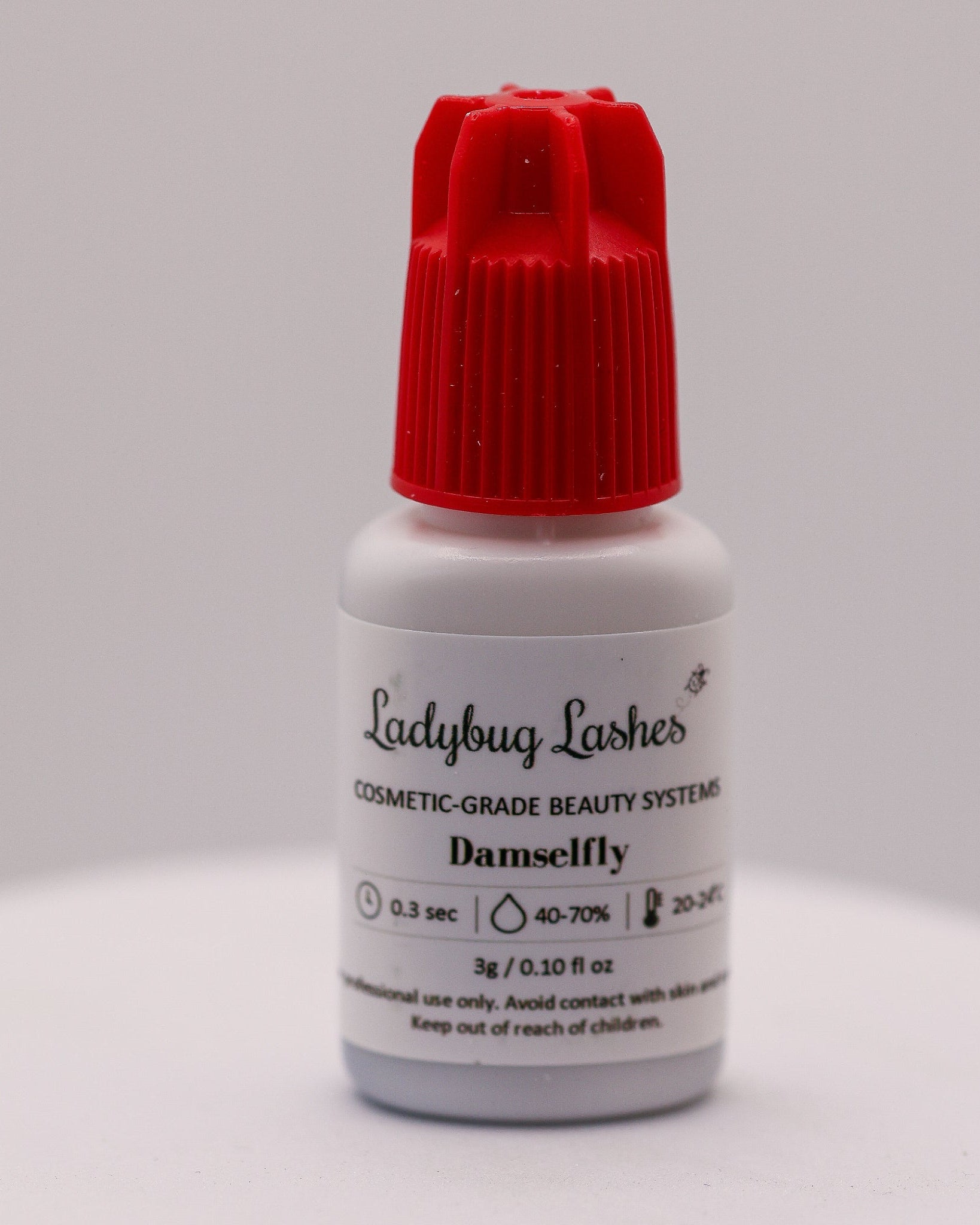
A Real Example from a Ladybug Lashes SDS
Let's use one of our own adhesive Safety Data Sheets as an example.
| Ingredient | SDS concentration | What it does |
|---|---|---|
| Ethyl-2-Cyanoacrylate | 50–100% | Main bonding component |
| Trimethylolpropane Triacrylate (TMPTA) | <0.9% | Contributes to the cured formulation and polymer structure |
| Butylated Hydroxyanisole (BHA) | <0.1% | Part of the stabilising system |
| Carbon Black | 0.1–1% | Provides the black pigment |
Notice that you can't turn those figures into an exact recipe.
Ethyl-2-Cyanoacrylate alone is given as a range of 50–100%.
That doesn't mean we don't know how much cyanoacrylate is actually in our adhesive.
It means you're looking at information presented for a Safety Data Sheet, rather than our exact manufacturing formulation.
Now let's translate those chemical names into normal lash-artist language.
Ethyl-2-Cyanoacrylate: The Bond
This is probably the ingredient most lash artists recognise.
Ethyl-2-Cyanoacrylate is the main adhesive-forming component.
It polymerises rapidly in the presence of moisture, changing the liquid adhesive into the polymerised bond between the lash extension and natural lash.
The easy way to remember it:
Cyanoacrylate = the bond.
Its reactivity is also one of the reasons your working conditions and application technique can affect how an adhesive behaves.
TMPTA: Part of the Cured Adhesive Structure
Trimethylolpropane Triacrylate, or TMPTA, is a multifunctional acrylate.
It doesn't perform exactly the same job as cyanoacrylate.
It contributes to the polymer network and properties of the cured formulation.
You don't need to memorise the chemistry.
The important lesson is simply:
Different ingredients have different jobs.
BHA: Helping Keep the Adhesive Stable
Butylated Hydroxyanisole, or BHA, forms part of the stabilising system in our formulation.
And stabilisation is something we believe lash artists should understand.
Cyanoacrylate is deliberately reactive.
We want that reaction when we're creating the lash bond.
What we don't want is unwanted polymerisation while the adhesive is being correctly stored inside its bottle.
That's why stabilisation is an important part of the formulation.
The easiest way to remember it is:
The adhesive needs to react - just not until we want it to.
Why Should You Know What Stabiliser Is in Your Lash Adhesive?
Most lash artists know to ask:
“What cyanoacrylate does this adhesive contain?”
We think another important question is:
“What is being used to stabilise it?”
Professional lash artists can work repeatedly and at close proximity with adhesive. Different chemical substances have different properties, classifications and safety considerations.
That doesn't mean a particular stabiliser is automatically unsafe, nor does it mean the stabiliser is automatically responsible if an artist or client experiences a reaction.
But knowing its identity matters.
For us, transparency shouldn't stop at:
“Our adhesive contains cyanoacrylate.”
We believe professional artists should be able to understand:
What creates the bond.
What contributes to the formulation.
What stabilises it.
What gives it colour.
You're working with the product regularly. We think knowing what's doing what inside that bottle helps you make a more informed choice.
Less Than 0.1% - Does It Really Matter?
Yes.
Our SDS lists BHA at less than 0.1%.
It's very easy to look at such a small number and assume that ingredient isn't particularly important.
But that's not how formulations work.
An ingredient can be present at a very low concentration and still perform an important technical function.
In this example, BHA performs a stabilising role despite being present at less than 0.1%.
So remember:
Small percentage doesn't automatically mean unimportant ingredient.
Both what the chemical is and how much of it is present can matter when you're understanding a product.
Carbon Black: The Colour
This one is much simpler.
Carbon Black is the pigment.
It provides the black colour in a traditional black lash adhesive.
It isn't creating the primary adhesive bond and it isn't the stabiliser.
The easy version:
Carbon Black = the colour.
So What Does Everything Do?
Using our own formulation information as the example:
Ethyl-2-Cyanoacrylate → creates the bond
TMPTA → contributes to the cured formulation
BHA → contributes to stabilisation
Carbon Black → provides the colour
Suddenly that intimidating list of chemical names becomes much easier to understand.
What Do Those H-Codes Mean?
You may see codes such as H315, H317, H319 and H335 alongside ingredients on an SDS.
These are standardised hazard statement codes.
Depending on the substance and classification, they can communicate hazards such as:
- Skin irritation
- Allergic skin reaction
- Serious eye irritation
- Respiratory irritation
They aren't random codes created by the adhesive manufacturer.
You don't need to memorise every H-code.
The important thing is to read the hazard information rather than skipping past it.
Don't Stop at Section 3
The composition table isn't the only useful part of an adhesive SDS.
Another section worth looking at is:
Section 10 – Stability and Reactivity
This provides information about things such as:
- Chemical stability
- Possible hazardous reactions
- Conditions to avoid
- Incompatible materials
- Hazardous decomposition products
For something as reactive as cyanoacrylate adhesive, this is useful information.
The SDS as a whole exists to help professionals understand a product's hazards and safe handling - not simply to provide an ingredient list.
Does Every Lash Adhesive Contain the Same Ingredients?
No.
Two adhesives can both be cyanoacrylate-based while having differences elsewhere in their formulations.
Different products may use different:
- Cyanoacrylates
- Stabilising systems
- Pigments
- Polymers
- Reactive modifiers
- Other formulation components
That's why you shouldn't assume you know what's in one lash adhesive simply because you've read about another.
Read the information for the actual adhesive you're working with.
What Should I Look for When Reading a Lash Adhesive SDS?
You don't need to understand every piece of chemistry.
Start with some simple questions:
- What is the main cyanoacrylate?
- What other substances are disclosed?
- What are their CAS numbers?
- Are the concentrations exact percentages, ranges or limits?
- What does each disclosed ingredient actually do?
- What is being used to stabilise the adhesive?
- What does Section 10 say about stability and reactivity?
- What hazards are identified?
- What handling and storage conditions are specified?
And if something doesn't make sense, ask the supplier.
You don't need a chemistry degree to ask sensible questions about an adhesive you work with regularly.
The Bottom Line
A Safety Data Sheet can tell you a huge amount about your lash adhesive - if you know how to read it.
But don't mistake it for a recipe.
A composition table that doesn't add up to 100% isn't automatically wrong or incomplete.
And if a table contains exact percentages that total exactly 100%, remember what that actually means mathematically: those figures account for the whole mixture. If other formulation ingredients are also present, they have to be accounted for somewhere within that 100%.
So don't just look for a satisfyingly neat total.
Look beyond the arithmetic.
Understand what has been disclosed, whether you're looking at exact concentrations or ranges, what the ingredients actually do, what their CAS numbers identify and what the SDS tells you about hazards and stability.
And don't only ask which cyanoacrylate you're working with.
We believe you should know what is stabilising your adhesive too.
You don't need to be a chemist.
But as a professional working with lash adhesive regularly, you should understand what you're working with.
'%3e%3cg id='Final-Copy-2_2_' transform='translate(1275.000000, 200.000000)'%3e%3cpath class='st0' d='M7.4,12.8h6.8l3.1-11.6H7.4C4.2,1.2,1.6,3.8,1.6,7S4.2,12.8,7.4,12.8z'/%3e%3c/g%3e%3c/g%3e%3c/g%3e%3cg id='final---dec.11-2020'%3e%3cg id='_x30_208-our-toggle' transform='translate(-1275.000000, -200.000000)'%3e%3cg id='Final-Copy-2' transform='translate(1275.000000, 200.000000)'%3e%3cpath class='st1' d='M22.6,0H7.4c-3.9,0-7,3.1-7,7s3.1,7,7,7h15.2c3.9,0,7-3.1,7-7S26.4,0,22.6,0z M1.6,7c0-3.2,2.6-5.8,5.8-5.8 h9.9l-3.1,11.6H7.4C4.2,12.8,1.6,10.2,1.6,7z'/%3e%3cpath id='x' class='st2' d='M24.6,4c0.2,0.2,0.2,0.6,0,0.8l0,0L22.5,7l2.2,2.2c0.2,0.2,0.2,0.6,0,0.8c-0.2,0.2-0.6,0.2-0.8,0 l0,0l-2.2-2.2L19.5,10c-0.2,0.2-0.6,0.2-0.8,0c-0.2-0.2-0.2-0.6,0-0.8l0,0L20.8,7l-2.2-2.2c-0.2-0.2-0.2-0.6,0-0.8 c0.2-0.2,0.6-0.2,0.8,0l0,0l2.2,2.2L23.8,4C24,3.8,24.4,3.8,24.6,4z'/%3e%3cpath id='y' class='st3' d='M12.7,4.1c0.2,0.2,0.3,0.6,0.1,0.8l0,0L8.6,9.8C8.5,9.9,8.4,10,8.3,10c-0.2,0.1-0.5,0.1-0.7-0.1l0,0 L5.4,7.7c-0.2-0.2-0.2-0.6,0-0.8c0.2-0.2,0.6-0.2,0.8,0l0,0L8,8.6l3.8-4.5C12,3.9,12.4,3.9,12.7,4.1z'/%3e%3c/g%3e%3c/g%3e%3c/g%3e%3c/g%3e%3c/svg%3e) Your Privacy Choices
Your Privacy Choices